The “Ogarnij cyfrowy świat” (Get a Grip on the Digital World) webinar series
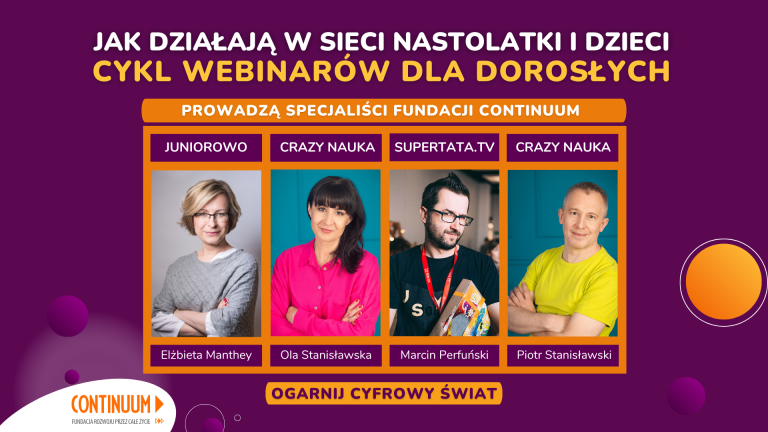
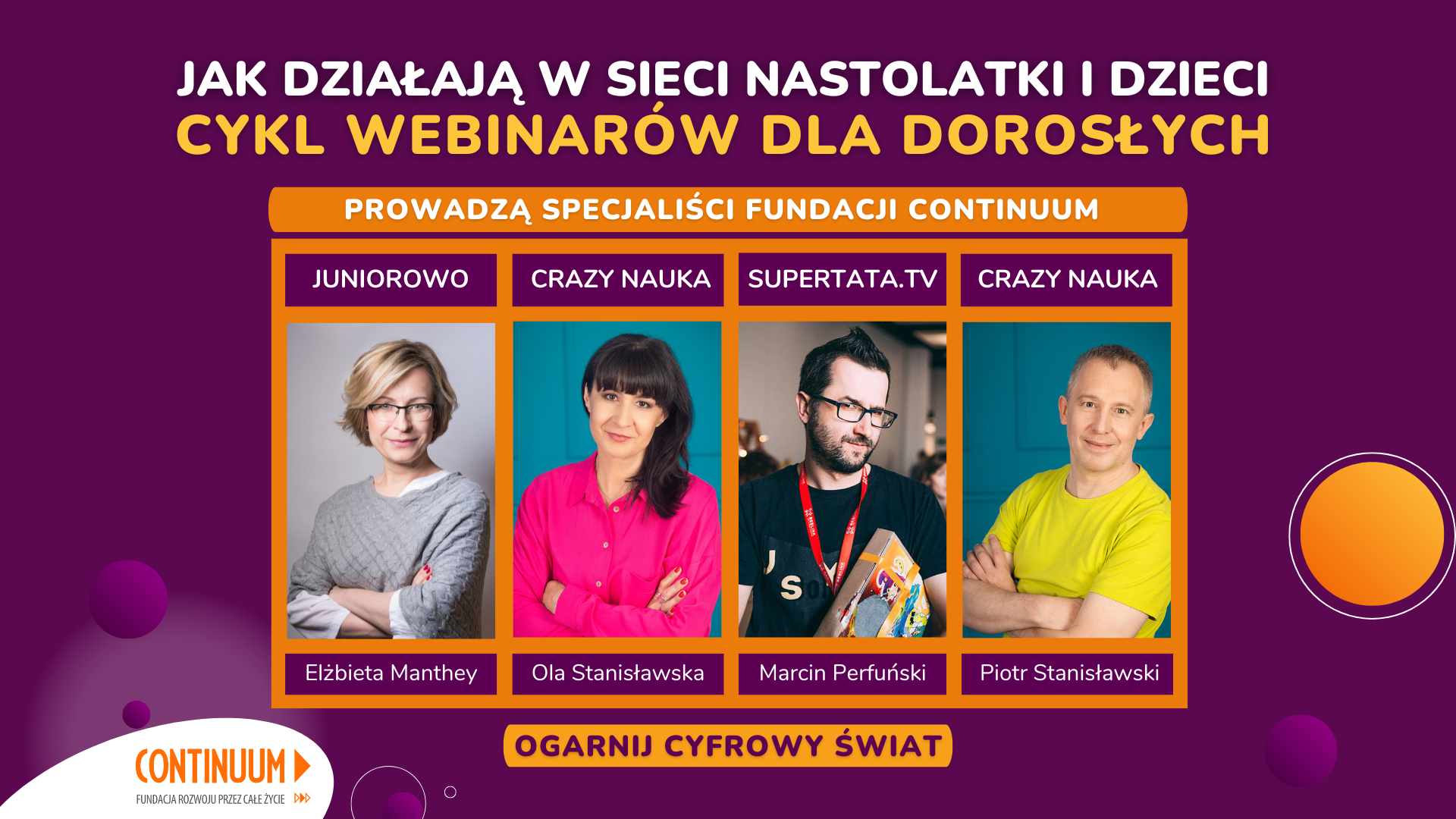
Together with the popular educational blogs Crazy Nauka, Juniorowo and Supertata.tv, our Foundation has prepared a series of webinars for adults on how teenagers and children function online.
In the webinar series “Ogarnij cyfrowy świat” (Get a grip on the digital world), together with the outstanding specialists we invite, we answer the following questions:
- What do adults not know about children online?
- Why can’t children tear themselves away from screens?
- What in digital media really harms teenagers?
- Is it enough to limit screen time?
- Who manages and manipulates us in the digital world, and how?
- How can we get a grip on digital media (so that they don’t get a grip on us)?
You have surely noticed that these have recently become hot topics, while at the same time being badly neglected, especially in adult education. That is why Fundacja Rozwoju Przez Całe Życie (Continuum Foundation) has joined forces with three highly regarded educational blogs: Crazy Nauka, Juniorowo and Supertata.tv.
Together we have prepared for you a fascinating, reliable dose of knowledge about the digital world of teenagers, children and… all of us, because social media algorithms and psychological and sales mechanisms don’t care how old you are 😉
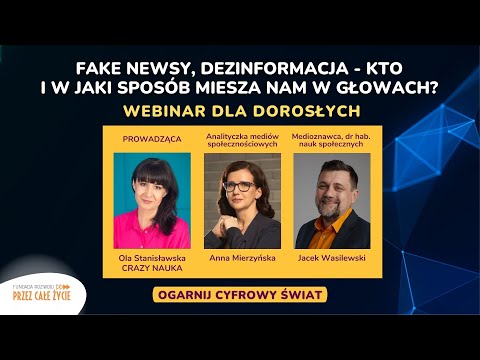
On 1 October 2024 we held the webinar “Fake newsy, dezinformacja – kto i w jaki sposób miesza nam w głowach?” (Fake news, disinformation – who is messing with our heads, and how?).
Ola Stanisławska’s guests were:
- Anna Mierzyńska – a social media analyst who works with OKO.press, among others;
- Prof. Jacek Wasilewski – a media scholar holding a habilitation (higher doctorate) in social sciences.
Together they discussed:
- How can disinformation be recognised?
- Which psychological tools and mechanisms does it use most often?
- Which topics does it most often concern?
- How can we avoid being taken in by disinformation content?

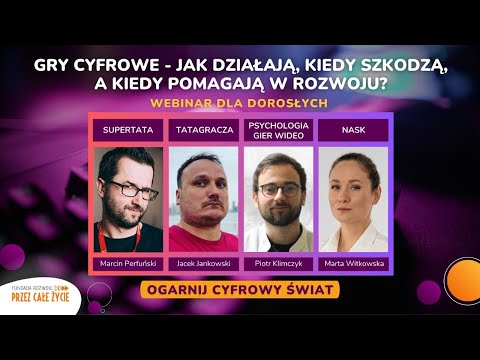
On 18 June 2024 we held the webinar “Gry cyfrowe – jak działają, kiedy szkodzą, a kiedy pomagają w rozwoju?” (Digital games – how do they work, when do they harm and when do they help development?).
In conversation with experts, Marcin Perfuński explored this subject in depth, trying to dispel the myths surrounding it. The world of digital games seems close at hand – it is in our smartphones, consoles and computers – yet we often know little about it. We can see that children are able to lose themselves in it, invest their emotions in it and sometimes considerable amounts of money too. But why does this happen, what can we do about it, and should we actually be worried?
The webinar’s guests were:
- Marta Witkowska – psychologist and psychotherapist, digital education expert at the NASK National Research Institute;
- Piotr Klimczyk – founder of the website Psychologia Gier Wideo (Video Game Psychology), assistant lecturer at Akademia Nauk Stosowanych Stefana Batorego (Stefan Batory Academy of Applied Sciences), school psychologist at Maria Skłodowska-Curie Primary School No. 4 in Skierniewice;
- Jacek Jankowski – lectures on the use of games in marketing and combines gaming with advertising and educational activities. On TikTok he runs the profile TataGracza.

On 15 May at 7 p.m. we held the webinar Jak nie wpadać w pułapki schematów myślenia? My, nastolatki, media (How not to fall into the traps of thinking patterns? Us, teenagers, the media).
How can we protect ourselves online from messages that exploit our tendency towards cognitive biases? How can we resist our natural inclination to listen to those who “tell it like it is”?
Ola Stanisławska’s guest was:
- Konrad Ciesiołkiewicz, PhD in social sciences, psychologist and political scientist, president of Fundacja Orange (Orange Foundation), initiator and co-author of the Karta Praw Dziecka w Biznesie (Charter of Children’s Rights in Business).

During the webinar Mózg nastolatka w cyfrowym świecie (The teenage brain in the digital world), held on 24 April 2024, we talked about:
- What should we know about the developmental stages of the human brain?
- Are brains loners, individualists, or maybe “it depends”?
- What does the craving for likes really tell us about young people’s needs?
- How does the human brain change under the influence of digital media?
The guests of Marcin Perfuński from the Supertata.tv blog were:
- Joanna Szulc – psychologist, sociologist, author of books and articles for parents, and editor. She works on supporting children’s development, the parent-child relationship, teenagers’ problems, the sexual development of children and young people, and helping families through separation and divorce.
- Anna Kosater – psychologist and certified sexologist, social skills trainer, psychotherapist and academic teacher. She provides individual therapy for children, young people and adults, as well as training sessions and workshops.

On 26 March 2024 at 7 p.m. we held the online meeting “jak zasięgowi influencerzy zarabiają na dzieciach?” (How do high-reach influencers make money from children?). Watch the stream on Facebook and YouTube!
The guests of Ola Stanisławska from our Foundation and Crazy Nauka were:
🔹 Dorota Minta, psychologist and psychotherapist from Instytut Wsparcia Psychologicznego ESTARE (ESTARE Institute of Psychological Support)
🔹 Marta Soja-Bochenek, influencer marketing specialist, Pomarańczowa Mysh (Orange Mysh)

On 21 February 2024 at 7 p.m. we held the fourth online meeting, “Jak nowe technologie manipulują nami wszystkimi?” (How do new technologies manipulate all of us?). Watch the stream on Facebook and YouTube!
The guests of Ola Stanisławska from our Foundation and Crazy Nauka were:
🔹 Dr hab. Dominik Batorski – sociologist, social network researcher and data scientist at ICM, University of Warsaw (ICM UW)
🔹 Krzysztof Manthey – lecturer on MBA programmes, crisis psychologist and crisis interventionist, educator, founder of FRPCZ

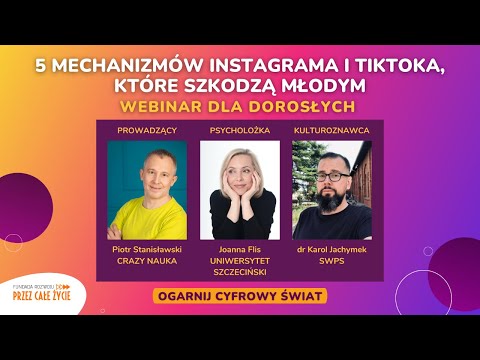
On 13 December, during the second webinar, we talked about “5 mechanizmów Instagrama i TikToka, które szkodą młodym” (5 mechanisms of Instagram and TikTok that harm young people):
On 10 January 2024 at 7 p.m. we held the third meeting. The topic was: “Dlaczego my, dorośli, nie rozumiemy nastolatków – pokolenia, które żyje w sieci?” (Why don’t we adults understand teenagers – the generation that lives online?)
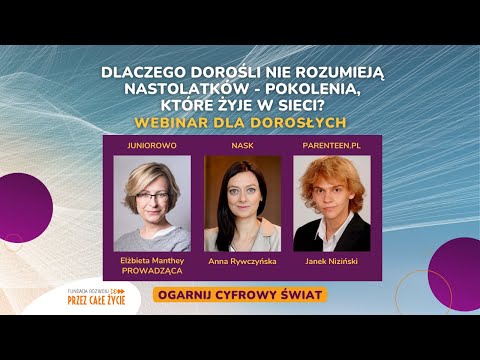
The guests of Elżbieta Manthey from our Foundation and from Juniorowo were:
- Dr Anna Rywczyńska, Head of the Cyber Threat Prevention Department at NASK
- Janek Niziński – co-founder of Parenteen.pl and creator of the “Lepiej Nie Widzieć” (Better Not to See) workshops, in which he helps parents get to know and understand the world of their teenage children.
On 22 November the first of our webinars took place: “Jak działają w sieci nastolatki i dzieci” (How teenagers and children function online):
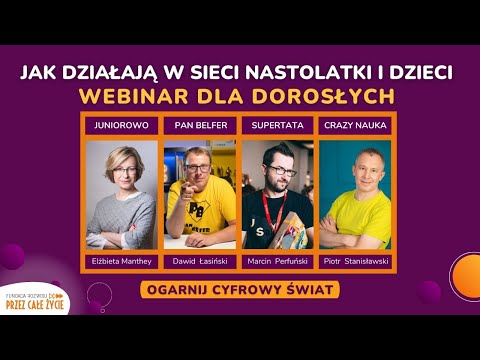
Our webinars are aimed at those of you who want to learn, understand and experience how the teenagers and children close to you function online. So that you can accompany and support them there, rather than forbidding, ordering and grounding them.
Look out for new webinars in the “Ogarnij cyfrowy świat” series every month!